
When a laboratory manager or procurement professional in India searches for reliable laboratory autoclave manufacturers in India, the goal is to find equipment that delivers consistent steam sterilization while meeting Indian regulatory standards. In this guide we explore how autoclaves work, the varieties offered by Indian manufacturers, key specifications to compare, and practical tips for selecting, installing, and maintaining these critical devices.
Table of Contents
- How a Laboratory Autoclave Operates – The Core Working Principle
- Key Types of Autoclaves Offered by Indian Manufacturers
- Applications Across Sectors
- Practical Selection Criteria for Procurement Teams
- Comparison with Alternative Sterilization Technologies
- Installation, Calibration, and Routine Maintenance
- Common Mistakes to Avoid
- Frequently Asked Questions
- Final Verdict and Practical Recommendations
How a Laboratory Autoclave Operates – The Core Working Principle
All laboratory autoclaves rely on saturated steam under pressure to achieve sterilization. The process follows three basic phases:
- Heating phase: Water is boiled, generating steam that fills the chamber and raises the temperature above 100 °C.
- Sterilization phase: Pressure is increased (typically 0.1–0.2 MPa) to raise the steam temperature to 121 °C or 134 °C for a set dwell time (usually 15–30 minutes). The combination of heat, moisture, and pressure destroys bacterial spores, viruses, and fungi.
- Cooling and drying phase: Steam is vented, and the chamber cools to a safe handling temperature. Some models include a vacuum‑dry cycle to remove residual moisture.
The fundamental physics is governed by the World Health Organization’s guidelines on steam sterilization, which specify temperature, pressure, and exposure time needed for validated sterility assurance.
Key Types of Autoclaves Offered by Indian Manufacturers
Indian suppliers produce a range of configurations to suit diverse laboratory environments:
- Bench‑top (compact) autoclaves: Ideal for teaching labs, small research groups, or quality‑control units with limited space.
- Vertical (tower) autoclaves: Provide larger chamber volumes (up to 50 L) and are common in pharmaceutical batch testing and microbiology labs.
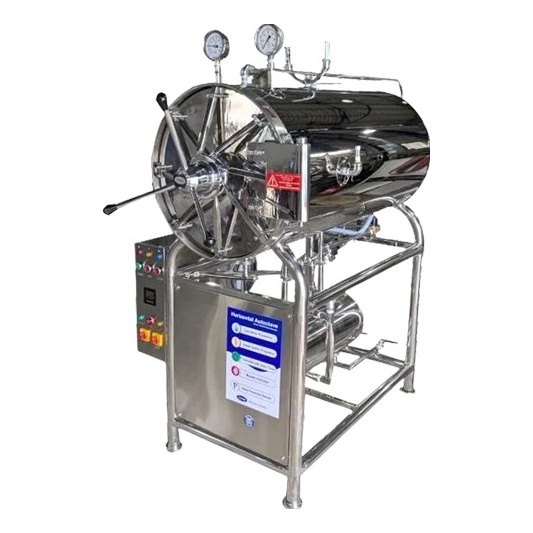
- Horizontal (door‑type) autoclaves: Offer easy loading of trays and racks; preferred for high‑throughput sterilization.
- Semi‑automatic vs. fully automatic: Semi‑automatic units require manual loading and unloading, while fully automatic models integrate programmable cycles, data logging, and remote monitoring.
- Vacuum‑assist models: Include a vacuum pump to remove air before steam entry, ensuring faster heat penetration and a dry final product.
Typical Specifications to Compare
When reviewing catalogues from laboratory autoclave manufacturers in India, focus on the following parameters:
- Temperature range (usually 121 °C – 134 °C)
- Maximum pressure (0.1 MPa to 0.3 MPa)
- Chamber capacity (from 2 L to 50 L)
- Cycle time (standard 15 min at 121 °C, plus heating/cooling)
- Control interface (digital LCD, PLC, remote IoT connectivity)
- Construction material (stainless‑steel 304/316, corrosion‑resistant gaskets)
- Safety features (over‑pressure relief valve, door interlock, temperature sensors)
- Compliance certifications (ISO 13485, IS 13485, CE marking, Indian Pharmacopoeia)
Applications Across Sectors
Autoclaves are indispensable in many Indian laboratory settings:
- Pharmaceutical manufacturing: Sterilizing media, glassware, and reusable instruments for GMP‑compliant processes.
- Academic and research institutions: Decontaminating microbiological cultures, agar plates, and reusable plastic ware.
- Hospital and clinical labs: Ensuring safe reuse of surgical tools, biopsy instruments, and diagnostic kits.
- Food‑testing labs: Sterilizing equipment used for microbiological analysis of food samples.
- Industrial quality control: Preparing sterile environments for material testing in sectors such as petrochemicals and cosmetics.
Practical Selection Criteria for Procurement Teams
A systematic approach helps avoid costly mismatches. Consider the following checklist when evaluating laboratory autoclave manufacturers in India:
- Capacity vs. workload: Estimate the volume of items per day. A 10 L vertical unit may suffice for a mid‑size QC lab, while a 30 L horizontal model suits high‑throughput microbiology facilities.
- Footprint and utilities: Verify available floor space, electrical supply (220 V/380 V), and water source. Bench‑top models need only a standard outlet, whereas larger vertical units may require three‑phase power.
- Regulatory compliance: Ensure the autoclave meets the Indian Pharmacopeia (IP) and, if exporting, CE or ISO standards.
- Control and data logging: For GMP environments, electronic records of each cycle are mandatory. Look for models with USB or Ethernet logging.
- After‑sales support: Availability of spare parts, on‑site service contracts, and calibration services can reduce downtime.
- Warranty and training: A minimum 12‑month warranty and on‑site operator training are hallmarks of reputable manufacturers.
Comparison with Alternative Sterilization Technologies
While steam autoclaving remains the gold standard, other methods are sometimes considered:
- Dry heat ovens: Useful for heat‑stable items but require longer cycles (2–4 hours) and cannot sterilize porous materials.
- Ethylene oxide (EtO) chambers: Offer low‑temperature sterilization for heat‑sensitive devices, but involve toxic gases, long aeration times, and stringent regulatory oversight.
- Radiation (gamma or electron beam): Suitable for bulk sterilization of disposable items but demand specialized facilities and high capital cost.
For most laboratory applications in India, a steam autoclave provides the best balance of cost, cycle time, and validated sterility assurance.
Installation, Calibration, and Routine Maintenance
Proper commissioning ensures reliable performance:
- Installation: Place the autoclave on a level, vibration‑free surface. Connect to a dedicated water line with a pressure‑reducing valve and ensure proper drainage.
- Calibration: Verify temperature and pressure sensors using a calibrated reference thermometer and pressure gauge. Calibration should be documented annually per ISO 13485.
- Cleaning: After each use, remove residues, wipe interior walls with a mild detergent, and run a “clean‑cycle” at 121 °C for 10 minutes. Replace gaskets every 12‑18 months.
- Troubleshooting tips: Common alerts include “door not locked” (check latch), “over‑pressure” (inspect vent valve), and “temperature sensor fault” (re‑calibrate or replace sensor).
Common Mistakes to Avoid
Even experienced lab managers can fall into pitfalls:
- Loading items too tightly, preventing steam circulation.
- Using non‑stainless‑steel accessories that corrode under high temperature.
- Skipping pre‑sterilization cleaning, leading to bio‑film formation.
- Neglecting regular validation of cycles, which can compromise sterility assurance.
- Choosing a model based solely on price without evaluating warranty and service network.
Frequently Asked Questions
What is the typical lifespan of a laboratory autoclave in India?
With regular maintenance, a well‑built stainless‑steel autoclave can operate reliably for 10‑15 years. Critical components such as door seals and pressure valves may need replacement sooner.
Are Indian‑made autoclaves compliant with international standards?
Many Indian manufacturers obtain ISO 13485, CE, and IS 13485 certifications, ensuring they meet global quality and safety benchmarks. Always request certification documents before purchase.
Can I use a laboratory autoclave for medical devices?
Yes, provided the device is heat‑stable and the autoclave cycle meets the device’s sterilization specifications. For critical medical devices, refer to the manufacturer’s instructions and validate the cycle.
How much does a bench‑top autoclave cost in India?
Pricing varies by capacity and features. A basic 2‑L semi‑automatic unit may start around INR 80,000, while a fully automatic 10‑L model with data logging can be upwards of INR 250,000. Exact quotes depend on accessories and service contracts.
Do Indian manufacturers provide installation and training?
Reputable suppliers typically include on‑site installation, operator training, and a user manual in English and regional languages (e.g., Tamil, Hindi). Confirm these services in the purchase agreement.
Final Verdict and Practical Recommendations
Choosing the right autoclave hinges on matching capacity, control features, and compliance requirements to your laboratory’s workload. Prioritize manufacturers that offer documented ISO certification, a robust after‑sales network, and clear warranty terms. Evaluate the total cost of ownership—not just the purchase price—by factoring in installation, calibration, spare‑part availability, and energy consumption.
For procurement teams in Chennai, Mumbai, Delhi, or elsewhere in India, a focused discussion with a trusted supplier can clarify which model aligns with your SOPs and regulatory obligations.
Explore our range of autoclaves and request a detailed quotation today. Our technical specialists can guide you through specifications, installation planning, and compliance verification to ensure seamless integration into your laboratory workflow.
