When you search for laboratory fume hood manufacturers in Chennai, you are looking for partners who can deliver reliable engineering, compliance with Indian safety standards, and responsive after‑sales service. In laboratory practice, a well‑designed fume hood protects personnel from toxic vapours, volatile solvents, and particulate matter while maintaining a stable working environment. This guide explains how fume hoods work, the varieties available, key specifications to compare, and practical steps to choose the right supplier in Chennai.
Table of Contents
- How a Laboratory Fume Hood Works – Core Principles
- Key Components and Their Functions
- Types of Laboratory Fume Hoods Commonly Offered by Chennai Manufacturers
- Technical Specifications to Compare
- Selection Criteria for Procurement Teams
- Comparison with Alternative Containment Technologies
- Installation, Calibration, and Routine Maintenance
- Common Mistakes to Avoid
- Frequently Asked Questions
- Final Verdict and Practical Recommendations
How a Laboratory Fume Hood Works – Core Principles
A fume hood is essentially a ventilated enclosure that draws contaminated air away from the user and exhausts it to the outside or through a filtration system. The primary mechanisms are:
- Airflow induction: A blower creates a negative pressure inside the hood, pulling air from the front opening toward the exhaust.
- Face velocity control: The speed of air across the opening (typically 0.4–0.5 m s⁻¹) determines containment efficiency.
- Make‑up air: Fresh air replaces the exhausted volume to prevent building pressure imbalance.
Modern hoods incorporate electronic sensors, variable‑speed fans, and alarm systems that warn users if face velocity drops below safe limits.
Key Components and Their Functions
Understanding each part helps you evaluate a supplier’s design quality.
- Hood canopy: Usually stainless steel (grade 304) for chemical resistance; some models use acrylic for visibility.
- Sash: Adjustable glass or acrylic panel that controls opening size and provides a visual barrier.
- Blower/fan assembly: Centrifugal or axial fans with motor ratings from 0.5 kW to 2 kW, selected based on required exhaust volume.
- Exhaust ductwork: Rigid steel ducts with smooth bends to minimise pressure loss; must meet IS 3030 (Industrial Exhaust Systems) standards.
- Control panel: Digital display showing face velocity, alarm status, and fan speed; some models integrate PLC‑based automation.
- Filters (optional): Activated carbon or HEPA filters for labs that recirculate air.
Types of Laboratory Fume Hoods Commonly Offered by Chennai Manufacturers
Constant‑Volume (CV) Hoods
These maintain a fixed exhaust flow regardless of sash position. They are simple, robust, and ideal for high‑throughput chemistry labs. However, they can be energy‑intensive because the fan runs at full speed even when the sash is closed.
Variable‑Air‑Volume (VAV) Hoods
VAV hoods adjust the exhaust flow based on sash opening, reducing energy consumption by up to 30 %. They require a reliable sensor and control system, which reputable Chennai manufacturers typically calibrate before delivery.
Ductless (Recirculating) Hoods
Equipped with activated carbon filters, ductless units are useful where external exhaust is impractical, such as in teaching labs or small research facilities. They are not suitable for highly toxic or radioactive vapours.
Walk‑In and Walk‑Through Cabinets
Large‑volume enclosures for bulk synthesis or sample preparation. They combine the containment of a fume hood with the space of a dedicated room.
Technical Specifications to Compare
When evaluating manufacturers, ask for a data sheet that includes:
- Maximum sash size (e.g., 900 mm × 600 mm)
- Exhaust flow rate (CFM or m³ h⁻¹)
- Face velocity range and alarm thresholds
- Construction material and finish (e.g., 304 stainless steel, powder‑coated)
- Power consumption and motor type
- Noise level (dB(A) at 1 m)
- Compliance certificates – IS 3030, ISO 14644‑1, and OSHA 1910.94
Selection Criteria for Procurement Teams
Application‑Specific Needs
Identify the chemicals or processes you will run. For solvent‑intensive work, a VAV hood with a high‑efficiency sash is advisable. For microbiology, a biosafety cabinet may be more appropriate, but a standard fume hood can still serve for non‑sterile tasks.
Space and Layout
Measure the bench width and ceiling height. Walk‑through cabinets need at least 2 m clearance, while bench‑top models can fit into a 1.2 m × 0.6 m footprint.
Energy Efficiency
Calculate the annual electricity cost based on fan power. VAV models usually offer a better return on investment for labs operating many hours per day.
After‑Sales Support
Choose a manufacturer that provides on‑site installation, calibration, and a spare‑parts inventory. In India, warranty terms of 12–24 months are common, but extended service contracts can safeguard long‑term uptime.
Comparison with Alternative Containment Technologies
While fume hoods are the workhorse for chemical vapour control, other options exist:
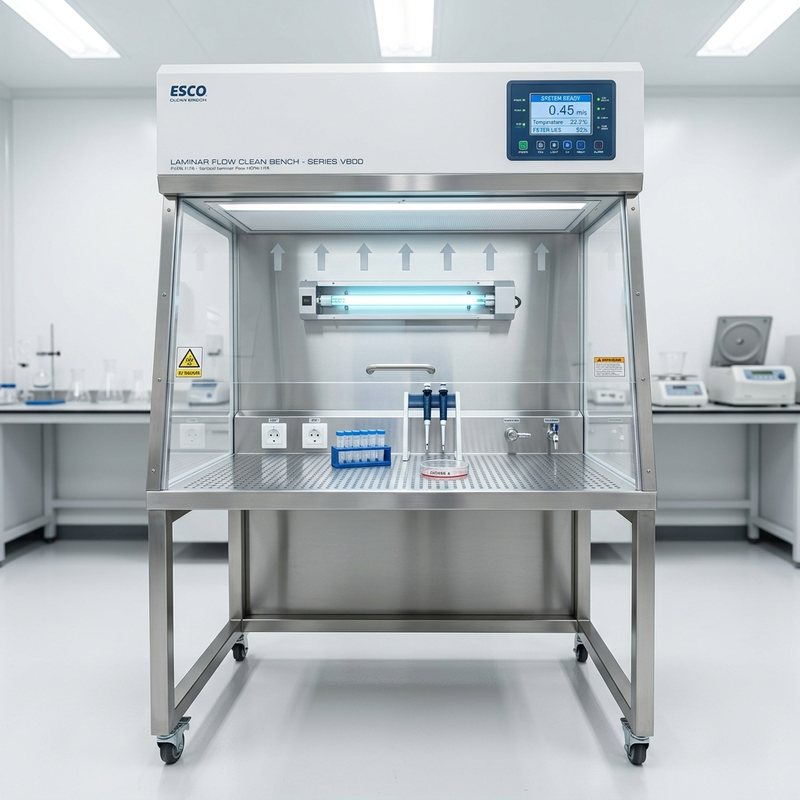
- Laminar Flow Cabinets: Provide sterile, particle‑free airflow but do not protect against toxic gases.
- Glove Boxes: Offer sealed environments for air‑sensitive or highly toxic work; however, they are more expensive and require rigorous leak testing.
- Local Exhaust Ventilation (LEV) Hoods: Fixed ceiling hoods that capture fumes at the source; suitable for large‑scale industrial labs.
For most academic and pharmaceutical labs in Chennai, a well‑specified fume hood remains the most cost‑effective solution.
Installation, Calibration, and Routine Maintenance
Proper installation is critical for performance:
- Ensure the exhaust duct is sized according to the hood’s flow rate (typically 1.5 × duct diameter).
- Verify that the make‑up air source does not create turbulence near the hood opening.
- Calibrate face‑velocity sensors using a calibrated anemometer; most manufacturers provide a 30‑day post‑installation service.
Maintenance checklist (monthly):
- Inspect sash hinges and replace worn seals.
- Clean interior surfaces with compatible solvents; avoid abrasive pads that damage stainless steel.
- Check fan belts (if belt‑driven) and replace if frayed.
- Test alarm functionality and verify that the control panel displays correct readings.
Common Mistakes to Avoid
Even experienced lab managers can overlook simple errors:
- Placing equipment directly in front of the hood opening, which disrupts airflow.
- Using the hood as storage space; clutter reduces effective capture velocity.
- Neglecting regular face‑velocity verification – a drop below 0.4 m s⁻¹ compromises safety.
- Choosing a hood solely on price without confirming compliance with IS 3030 or OSHA standards.
Frequently Asked Questions
What Indian standards apply to laboratory fume hoods?
The primary references are IS 3030 (Industrial Exhaust Systems) and OSHA Standard 1910.94, which defines face‑velocity limits and testing procedures. Compliance documentation should be provided by the manufacturer.
Can a fume hood be used for radioactive work?
Standard chemical fume hoods are not certified for radiological containment. For radioactive gases, a certified fume hood with HEPA and charcoal filters, plus a negative pressure monitoring system, is required.
How often should a fume hood be recertified?
In India, a formal recertification is recommended every 12 months, or sooner if the hood has been moved, if the sash mechanism is altered, or after major repairs.
Is a ductless hood suitable for a teaching laboratory?
Yes, if the curriculum involves low‑hazard solvents and the carbon filter capacity matches the expected usage. However, for high‑risk chemicals, a ducted system is mandatory.
What are the typical lead times for a custom‑fabricated hood in Chennai?
Lead times vary between 4‑8 weeks, depending on material thickness, filter integration, and control‑panel complexity. Discuss the schedule early to align with project timelines.
Final Verdict and Practical Recommendations
Choosing a reliable laboratory fume hood manufacturer in Chennai hinges on matching the hood’s technical specs to your lab’s workflow, ensuring compliance with IS 3030 and OSHA, and confirming robust after‑sales support. Prioritise VAV models for energy savings, verify face‑velocity calibration, and avoid shortcuts in installation.
For a trusted supplier that offers locally assembled stainless‑steel hoods, calibrated control panels, and a network of service technicians across Tamil Nadu, explore the product range on our website. Learn more about laboratory safety solutions from a reputable Chennai provider.
Stay compliant, stay safe, and let your laboratory’s performance thrive with the right fume hood.
For official safety guidelines, refer to the OSHA Standard 1910.94 on laboratory ventilation.