Laboratory managers and procurement teams often ask, “What is the Water Bath Price in India: Serological vs Circulating Models and which one fits my workflow?” The answer hinges on understanding the core technology, application demands, and the cost drivers that differentiate a static serological water bath from a dynamic circulating water bath. This guide walks you through the working principles, key specifications, buying criteria, and maintenance tips so you can make an informed decision for your lab in Chennai, Delhi, or any Indian city.
Table of Contents
- Working principle of water baths
- Water Bath Price in India: Serological vs Circulating Models – What Drives the Cost?
- Key specifications to compare for serological and circulating water baths
- Choosing the right model for your application
- Installation, calibration, and routine maintenance
- Common mistakes to avoid
- Frequently Asked Questions
- Final verdict and recommendation
Working principle of water baths
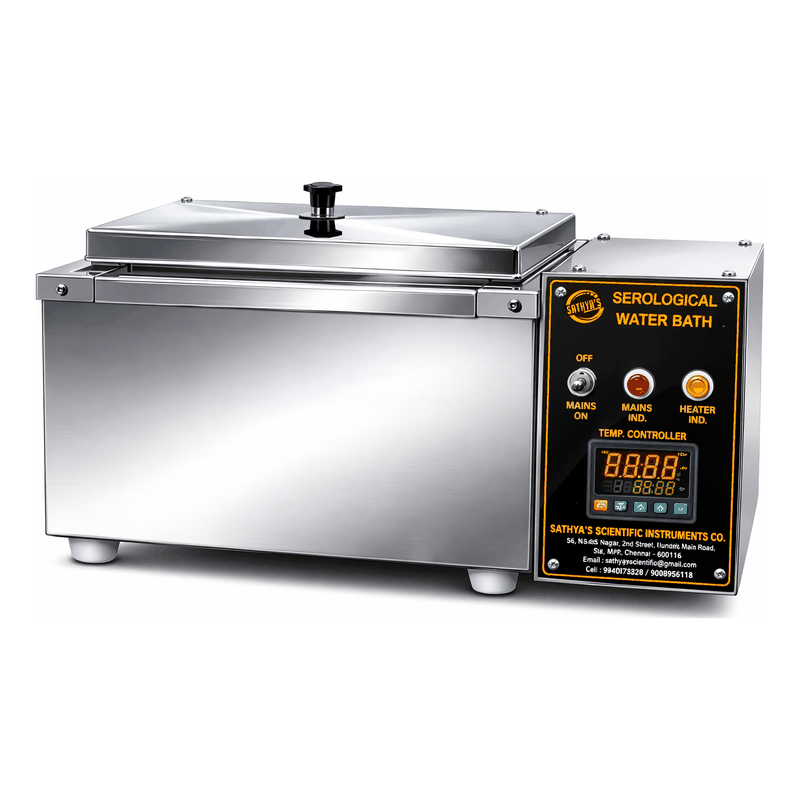
A water bath maintains a liquid medium at a set temperature, providing a uniform thermal environment for test tubes, flasks, or plates. In a serological (static) bath, the water sits still; a heating element and a thermostat control the temperature. Heat is transferred by conduction and natural convection within the tank. In a circulating bath, a built‑in pump creates forced convection, moving water around a closed loop. This circulation eliminates temperature gradients, delivering tighter temperature uniformity (often ±0.1 °C) across larger volumes.
Water Bath Price in India: Serological vs Circulating Models – What Drives the Cost?
Pricing varies widely because of several factors:
- Capacity and volume: Larger tanks require more stainless‑steel or glass, increasing material cost.
- Temperature range and accuracy: Circulating models typically offer a broader range (e.g., 5 °C – 99 °C) and tighter control, which adds to the price.
- Pump and motor quality: High‑speed, low‑noise pumps in circulating baths are a major cost component.
- Control interface: Touchscreen PID controllers, data logging, and USB connectivity raise the price compared to simple rotary knobs.
- Safety and certifications: BIS certification, CE marking, and compliance with IS 1347:2015 for laboratory equipment can add a premium.
- Brand and after‑sales service: Established distributors in India often bundle installation, calibration, and spare‑part support, influencing the final quote.
Key specifications to compare for serological and circulating water baths
When you evaluate the Water Bath Price in India: Serological vs Circulating Models, keep an eye on the following specs:
- Temperature range: 5 °C – 99 °C (typical) vs 0 °C – 100 °C for some high‑end circulators.
- Uniformity: ±0.5 °C (static) vs ±0.1 °C (circulating).
- Capacity: 2 L, 5 L, 10 L, 20 L, or larger.
- Construction material: 304 stainless steel interior, double‑wall insulation, optional glass lid.
- Control type: Mechanical dial, digital display, or PID touchscreen.
- Power consumption: 350 W – 1500 W depending on size and pump.
- Safety features: Over‑temperature shut‑off, water‑level alarm, and insulated housing.
Choosing the right model for your application
In laboratory practice, the decision often comes down to the nature of the assay:
- Serological water baths are ideal for routine incubation of culture tubes, enzyme assays, or sample thawing where precise uniformity is not critical.
- Circulating water baths excel in applications requiring tight temperature control, such as polymerase chain reaction (PCR) pre‑heating, kinetic enzyme studies, or calibration of temperature‑sensitive instruments.
For a pharmaceutical quality‑control lab in Mumbai, a circulating bath may be mandatory to meet GMP temperature‑uniformity specifications, whereas a teaching lab in Bangalore can comfortably operate with a serological unit.
Installation, calibration, and routine maintenance
Both models share similar setup steps:
- Place the bath on a level, vibration‑free bench with adequate clearance for the lid.
- Connect to a dedicated 220 V power outlet; avoid using extension cords.
- Fill with distilled water up to the indicated level; do not exceed the maximum mark.
- Run the self‑test (if available) and allow the unit to reach the set temperature before loading samples.
Calibration should be performed annually using a calibrated thermometer traceable to NIST or BIS standards. For circulating baths, inspect the pump impeller for wear and clean the circulation loop to prevent biofilm formation.
Common mistakes to avoid
- Using tap water without de‑ionisation – mineral deposits can reduce heating efficiency.
- Overfilling or underfilling – leads to inaccurate temperature readings and may trigger safety alarms.
- Neglecting regular cleaning – especially in circulating models where stagnant water can harbor microbes.
- Relying on the built‑in thermostat alone for critical assays – always verify with an external calibrated probe.
Frequently Asked Questions
What is the typical price range for a serological water bath in India?
Basic 5 L static units start around INR 30,000 to INR 55,000, while larger capacity or stainless‑steel models with digital controls can reach INR 80,000–INR 1,00,000.
How much more does a circulating water bath cost?
Circulating models generally carry a 30 %–60 % premium over static units due to the pump, enhanced control electronics, and tighter temperature uniformity. Expect prices from INR 70,000 for a 5 L unit to INR 1,50,000 for high‑capacity models.
Do I need a water bath with a lid?
A lid reduces evaporative loss and temperature drift, especially for long‑duration incubations. Most circulating baths include insulated lids as standard; many serological models offer optional lids.
Are there any Indian standards I must follow?
Yes. The Bureau of Indian Standards (BIS) IS 1347:2015 outlines safety and performance requirements for laboratory water baths. Compliance ensures the unit meets local regulatory expectations.
Can I use the same water bath for both microbiology and chemistry applications?
Technically yes, but consider cross‑contamination risk. Dedicated baths for microbiology (often with a lid and sterilizable interior) help maintain aseptic conditions.
Final verdict and recommendation
The Water Bath Price in India: Serological vs Circulating Models reflects a trade‑off between cost and temperature precision. For high‑throughput, temperature‑critical processes—such as pharmaceutical stability testing or advanced research—a circulating water bath justifies the higher investment. For routine incubations, sample thawing, or educational labs, a serological water bath offers reliable performance at a lower price point.
Before finalising your purchase, request a quotation that includes installation, calibration, and a warranty of at least one year. Verify that the supplier provides genuine spare parts and local technical support.
Ready to explore the options? Check out our serological water bath product page for detailed specifications and contact information.