Laboratory managers and researchers in Chennai, Bangalore, and across India often face the dilemma of selecting the right thermal processing equipment. The question Muffle Furnace vs Hot Air Oven: Which One Does Your Lab Need? hinges on factors such as temperature range, atmosphere control, sample size, and regulatory compliance. In this guide we break down the operating principles, key specifications, and practical considerations so you can make an informed decision for your facility.
Table of Contents
- Working Principles – How a Muffle Furnace Operates
- Working Principles – How a Hot Air Oven Operates
- Key Specifications to Compare
- Typical Applications in Indian Laboratories
- Selection Checklist – Choosing the Right Equipment for Your Lab
- Cost Drivers and Procurement Tips for Indian Buyers
- Maintenance, Safety, and Troubleshooting
- Common Mistakes to Avoid
- Frequently Asked Questions
- Final Verdict – Which One Fits Your Needs?
Working Principles – How a Muffle Furnace Operates
A muffle furnace is a sealed, high‑temperature chamber where the heating elements are isolated from the sample by a refractory “muffle” lining. Heat is transferred primarily by convection and radiation within the insulated cavity, allowing temperatures up to 1200 °C – 1600 °C with minimal contamination from combustion gases. Typical components include:
- Heating elements: Usually nickel‑chromium (NiCr) coils positioned around the furnace body.
- Refractory lining (muffle): Alumina or silicon carbide that protects the sample from direct contact with the metal shell.
- Temperature controller: Digital PID controller with thermocouple feedback for ±1 °C accuracy.
- Insulation: High‑density ceramic fiber to reduce heat loss and improve energy efficiency.
Because the interior is sealed, a muffle furnace can operate under inert gas (argon, nitrogen) or a reducing atmosphere, making it ideal for calcination, sintering, and material research where oxidation must be avoided.
Working Principles – How a Hot Air Oven Operates
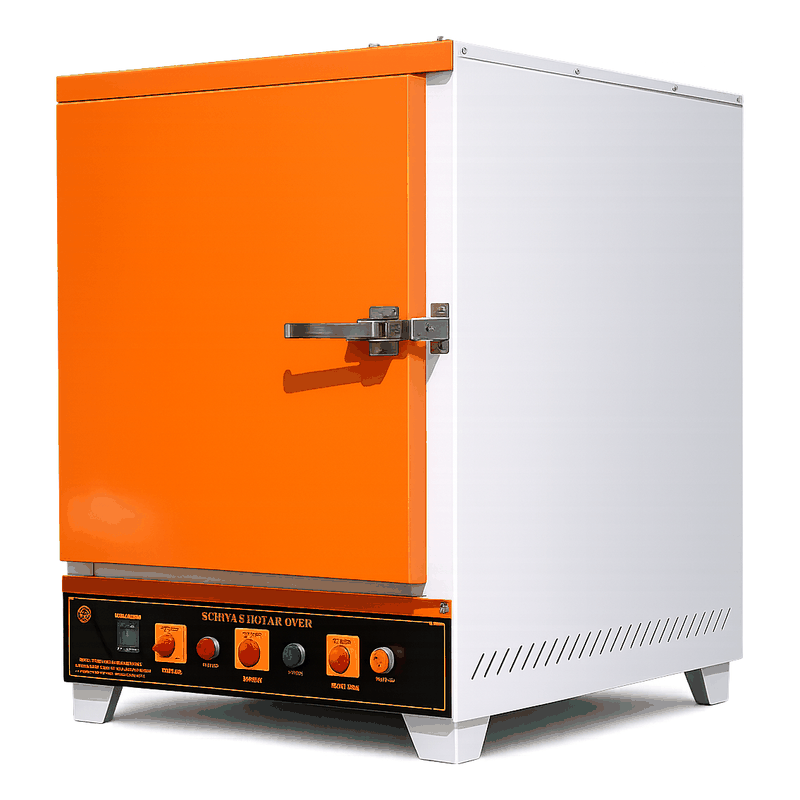
A hot air oven uses a forced‑air circulation system to distribute heat evenly across the chamber. Electric heating elements heat the air, which is then blown by a fan through a perforated tray system. The temperature range typically spans 50 °C – 300 °C, suitable for drying, sterilization, and polymer curing. Core components are:
- Heating elements: Tubular resistance coils.
- Fan and ductwork: Provides uniform airflow and reduces temperature gradients.
- Control panel: Often includes programmable timers, humidity control, and safety interlocks.
- Stainless‑steel interior: Easy to clean and resistant to corrosion.
Hot air ovens are open‑atmosphere devices; they cannot maintain an inert environment, which limits their use for high‑temperature oxidation‑sensitive processes.
Key Specifications to Compare
When evaluating Muffle Furnace vs Hot Air Oven: Which One Does Your Lab Need?, focus on the following parameters:
- Temperature range: Muffle furnaces reach 1200 °C +; hot air ovens top out around 300 °C.
- Temperature uniformity: ±1 °C in muffle furnaces (due to PID control) versus ±2–3 °C in hot air ovens.
- Atmosphere control: Muffle furnaces support inert or reducing gases; hot air ovens operate in ambient air.
- Capacity: Measured in liters; muffle furnaces often have smaller volumes (10–30 L) due to refractory walls, while hot air ovens can exceed 100 L.
- Safety features: Door interlocks, over‑temperature cut‑offs, and exhaust fans are standard on both, but muffle furnaces may require additional gas‑purge systems.
- Energy consumption: High‑temperature muffle furnaces consume more power; hot air ovens are more energy‑efficient for low‑temperature tasks.
Typical Applications in Indian Laboratories
Both instruments find extensive use across sectors, but their suitability differs:
- Pharmaceutical quality control: Hot air ovens for moisture content testing (IP / USP ), sterilization of glassware, and drying of APIs.
- Materials research: Muffle furnaces for ceramic sintering, metal oxide synthesis, and thermogravimetric studies.
- Environmental labs: Ashing of soil or waste samples in a muffle furnace to meet Bureau of Indian Standards (BIS) protocols.
- Educational institutions: Hot air ovens for routine microbiology and chemistry labs; muffle furnaces for undergraduate material science projects.
- Industrial quality assurance: Heat‑treatment of metal parts, polymer curing, and batch drying of pigments.
Selection Checklist – Choosing the Right Equipment for Your Lab
Use the following checklist to answer the core question of Muffle Furnace vs Hot Air Oven: Which One Does Your Lab Need?:
- What is the maximum temperature required for your processes?
- Do you need an inert or reducing atmosphere?
- What sample size and volume are typical?
- Is precise temperature uniformity critical (e.g., ±1 °C)?
- Do you require programmable cycles, humidity control, or rapid cooling?
- What are the space constraints and power availability in your lab?
- Are there specific Indian standards (BIS, IS) that the equipment must comply with?
Cost Drivers and Procurement Tips for Indian Buyers
In India, the price of a muffle furnace can be influenced by:
- Maximum temperature rating and refractory material quality.
- Automation level – programmable logic controllers (PLC) versus manual knobs.
- Size of the chamber and custom dimensions.
- After‑sales service network and availability of spare parts in Chennai or Hyderabad.
Hot air ovens are generally less expensive, but cost variations arise from:
- Temperature accuracy and uniformity specifications.
- Inclusion of humidity control or UV sterilization modules.
- Stainless‑steel grade (304 vs. 316) for corrosive environments.
When requesting quotations, ask suppliers for:
- Factory calibration certificates (ISO 9001 or BIS‑certified).
- Warranty period and on‑site installation support.
- Lead time for spare parts such as heating elements and thermocouples.
Maintenance, Safety, and Troubleshooting
Regular upkeep prolongs equipment life and ensures compliance with safety regulations:
- Cleaning: Remove residue after each run; for muffle furnaces, use a soft brush to avoid damaging the refractory lining.
- Calibration: Verify temperature accuracy annually with a calibrated thermocouple traceable to NIST or BIS standards.
- Inspection: Check door seals, fan bearings, and heating element integrity every six months.
- Troubleshooting tips: Temperature drift often indicates a failing thermocouple; uneven heating may be due to fan blockage in a hot air oven.
Common Mistakes to Avoid
- Using a hot air oven for processes that exceed 300 °C – this can damage the heating elements and void warranty.
- Loading samples too tightly in a muffle furnace, which creates hot spots and compromises uniformity.
- Neglecting gas‑purge lines when operating a muffle furnace under inert atmosphere, leading to oxidation of sensitive samples.
- Overlooking local power quality; voltage fluctuations can affect temperature stability, especially for high‑temperature furnaces.
Frequently Asked Questions
Can a hot air oven replace a muffle furnace for ash content analysis?
No. Ashing typically requires temperatures above 600 °C and a controlled atmosphere to prevent oxidation, which only a muffle furnace can reliably provide.
What is the typical lifespan of a laboratory muffle furnace?
With proper maintenance, a well‑built muffle furnace can operate for 10–15 years. Refractory lining may need periodic replacement after intensive use.
Are there energy‑saving modes available for hot air ovens?
Many modern models include eco‑mode or programmable standby that reduces power consumption between cycles.
Do Indian standards require a specific type of temperature controller?
IS 14425:1998 recommends PID controllers with ±1 °C accuracy for analytical ovens and furnaces used in quality control.
How important is after‑sales service in Chennai?
Very important. Rapid access to spare parts and local technicians minimizes downtime, especially for high‑throughput pharmaceutical labs.
Final Verdict – Which One Fits Your Needs?
If your applications demand temperatures above 600 °C, an inert atmosphere, or precise thermal cycling, the answer to Muffle Furnace vs Hot Air Oven: Which One Does Your Lab Need? is a Muffle Furnace. For routine drying, sterilization, and low‑temperature polymer work, a hot air oven offers sufficient performance at a lower cost and with easier maintenance. Evaluate the checklist above, align the equipment with Indian regulatory requirements, and choose a supplier that provides strong local support. Investing in the right thermal processor will enhance reproducibility, safety, and overall productivity in your laboratory.