Biochemical Oxygen Demand (BOD) testing is a cornerstone of water‑quality monitoring, wastewater treatment assessment, and environmental research. For lab technicians, understanding how a BOD incubator works: a simple guide for lab technicians is essential to obtain reliable results while keeping the workflow efficient. This article walks you through the operating principle, key components, practical selection tips, and maintenance best practices, with a focus on Indian laboratory environments such as Chennai and the broader Tamil Nadu region.
Table of Contents
- How a BOD Incubator Works: A Simple Guide for Lab Technicians – Core Operating Principles
- Key Components of a BOD Incubator
- Typical Applications in Indian Laboratories
- How a BOD Incubator Works: A Simple Guide for Lab Technicians – Selecting the Right Model
- Alternative Equipment: Bacteriological Incubator vs. BOD Incubator
- Installation, Calibration, and Routine Maintenance
- Common Mistakes to Avoid
- Frequently Asked Questions
- Final Verdict and Practical Recommendations
How a BOD Incubator Works: A Simple Guide for Lab Technicians – Core Operating Principles
A BOD incubator provides a temperature‑controlled environment, typically at 20 °C ± 0.5 °C, for the aerobic degradation of organic matter in a sealed sample. The process can be summarized in three steps:
- Sample preparation: A water sample is mixed with a seed inoculum and a nutrient solution, then placed in a sealed BOD bottle.
- Incubation: The sealed bottles are loaded into the incubator where a thermostatically regulated air stream circulates, maintaining a uniform temperature throughout the chamber.
- Measurement: After a standard 5‑day period (BOD5), the dissolved oxygen (DO) is measured using a DO meter or an automatic probe.
The incubator’s role is to keep the temperature stable and the air free from external contaminants that could alter microbial activity. Most modern units also monitor humidity and provide alarms for temperature excursions.
Key Components of a BOD Incubator
Understanding the hardware helps technicians troubleshoot quickly:
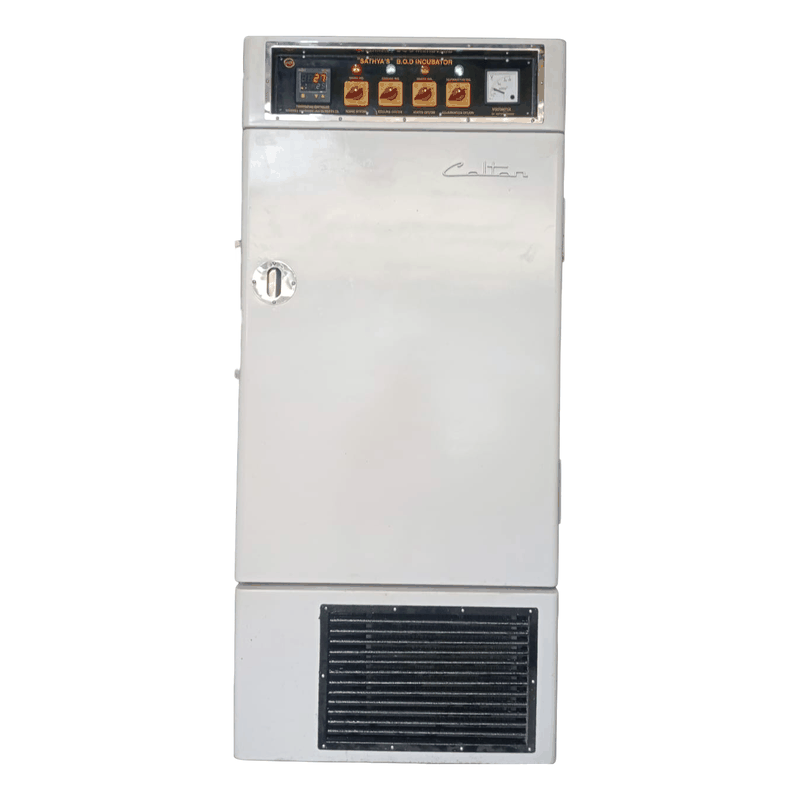
- Thermal chamber: Usually constructed from stainless steel with an insulated double‑wall to minimise heat loss.
- Heating/cooling system: Electric heating elements combined with a fan‑forced air circulation system. Some models use a Peltier module for fine temperature control.
- Temperature controller: A digital PID controller with a calibrated sensor (often a PT100) that maintains the set point with ±0.1 °C accuracy.
- Air filtration: HEPA or activated‑carbon filters prevent dust and volatile organic compounds from entering the chamber.
- Safety interlocks: Door switches that stop heating if the door is opened, and over‑temperature cut‑offs.
- Display & data logging: LCD panels show real‑time temperature, and many units store logs for audit trails.
Typical Applications in Indian Laboratories
In Chennai’s coastal research centres, BOD incubators are used for:
- Municipal wastewater treatment plant performance monitoring.
- Industrial effluent compliance testing for textile and leather units.
- Academic projects on biodegradability of agro‑chemical residues.
- Pharmaceutical process water validation.
Regulatory compliance often references the CDC guidelines for BOD testing, which specify incubation temperature and duration.
How a BOD Incubator Works: A Simple Guide for Lab Technicians – Selecting the Right Model
Choosing the appropriate incubator depends on workload, space, and budget. Consider the following criteria:
- Capacity: Small labs may need a 12‑bottle capacity, while large municipal labs often require 30‑50 bottles per run.
- Temperature accuracy: Look for ±0.1 °C or better, especially if you follow ISO 5667‑3.
- Uniformity: A temperature variation of less than 0.3 °C across the chamber is ideal for reproducibility.
- Power consumption: Energy‑efficient models are valuable in regions with high electricity costs.
- Service network: Verify that the supplier offers local support in Chennai or nearby cities.
Alternative Equipment: Bacteriological Incubator vs. BOD Incubator
While both devices maintain temperature, a bacteriological incubator is designed for agar plates, broth cultures, or microbial growth studies and typically operates at 35‑37 °C. In contrast, a BOD incubator is calibrated for the lower 20 °C range and includes sealed‑bottle handling features. Attempting BOD tests in a standard bacteriological incubator can lead to temperature bias and inaccurate oxygen demand results.
Installation, Calibration, and Routine Maintenance
Proper set‑up extends the life of the incubator and ensures data integrity:
- Installation: Place the unit on a level, vibration‑free surface away from direct sunlight. Provide at least 10 cm clearance on all sides for airflow.
- Calibration: Perform an initial calibration with a certified reference thermometer. Re‑calibrate annually or after any major service.
- Cleaning: Wipe the interior with a mild detergent after each batch. Avoid abrasive cleaners that could damage the stainless steel surface.
- Filter replacement: Change HEPA filters every 6‑12 months depending on usage intensity.
- Troubleshooting tips: If temperature drifts, check the door seal, fan operation, and sensor connection before calling service.
Common Mistakes to Avoid
Even experienced technicians can stumble on simple errors:
- Setting the incubator to 25 °C instead of the required 20 °C, which inflates BOD values.
- Leaving the door open during the 5‑day incubation, causing temperature fluctuations.
- Using bottles with cracked caps, leading to oxygen leakage and under‑estimation of demand.
- Neglecting to pre‑warm the incubator before loading samples, which creates a temperature gradient.
Frequently Asked Questions
What is the typical temperature range for a BOD incubator?
Most models operate between 15 °C and 30 °C, with 20 °C ± 0.5 °C being the standard for BOD5 tests.
Can I use a BOD incubator for BOD7 or BOD20 tests?
Yes, if the controller allows programmable set points. However, you must follow the relevant standard methods (e.g., APHA Standard Methods) for each incubation period.
How often should I service the incubator?
Annual preventive maintenance is recommended, with quarterly visual inspections of the door seal, fan, and temperature display.
Is a digital data logger mandatory?
While not legally required, a data logger simplifies compliance audits and provides traceability for ISO‑certified labs.
What warranty and after‑sales support are typical in India?
Suppliers usually offer 12‑month warranty on parts and a 24‑month warranty on labor. Look for a provider that can dispatch technicians within 48 hours in Chennai.
Final Verdict and Practical Recommendations
Understanding how a BOD incubator works: a simple guide for lab technicians equips you to select, operate, and maintain the instrument with confidence. Prioritise temperature accuracy, uniformity, and reliable local service when evaluating options. For labs in Chennai or elsewhere in Tamil Nadu, a model with stainless‑steel construction, digital PID control, and a proven service network will minimise downtime and ensure compliance with national and international water‑quality standards.
Ready to upgrade or purchase a new BOD incubator? Explore the range of certified units available at Sathya Scientific and request a quotation tailored to your laboratory’s capacity and budget.