In laboratory practice, selecting the correct chamber size is often the make‑or‑break factor for a successful experiment or production run. Whether you are a laboratory manager in Chennai, a research scientist in Tamil Nadu, or a procurement officer for a pharmaceutical plant, custom lab equipment manufacturing: how to get the right chamber size is a question that demands a systematic, data‑driven answer.
Table of Contents
- Understanding the Core Principles of Custom Lab Equipment Manufacturing: How to Get the Right Chamber Size
- Key Design Parameters That Influence Chamber Size
- Practical Steps to Size Your Custom Chamber
- Comparison with Off‑The‑Shelf Options
- Maintenance, Safety, and Troubleshooting
- Common Mistakes to Avoid When Specifying Chamber Size
- Frequently Asked Questions
- Final Verdict and Recommendations
Understanding the Core Principles of Custom Lab Equipment Manufacturing: How to Get the Right Chamber Size
The first step is to grasp the working principle of the chamber you need. Most chambers—whether incubators, humidity chambers, or high‑temperature ovens—operate on a closed‑loop control system that regulates temperature, humidity, and sometimes gas composition. Sensors feed real‑time data to a controller, which modulates heating elements, humidifiers, or cooling coils to maintain the set point within ±0.5 °C or ±2 % RH for most scientific applications.
Key Design Parameters That Influence Chamber Size
Several technical variables dictate the internal volume you should specify:
- Sample volume: The actual space occupied by the specimens, trays, or vials.
- Working clearance: Space needed for airflow, uniform temperature distribution, and safe access.
- Load type: Whether the load is static (e.g., a set of petri dishes) or dynamic (e.g., rotating shelves).
- Temperature and humidity gradients: Larger chambers may experience greater gradients, requiring more sophisticated circulation.
- Regulatory space requirements: ISO 13485, GMP, or BIS standards often prescribe minimum clearances for sterilization validation.
Sample Volume vs. Working Volume
Many buyers mistakenly equate the total sample volume with the chamber’s internal volume. In reality, you need to add 20–30 % extra space for airflow and to avoid “dead zones” where temperature may lag. A practical rule of thumb is:
Working Volume = Sample Volume × 1.25 – 1.35
Material Compatibility and Construction
Stainless steel (grade 304 or 316) is the default for most humidity chambers because it resists corrosion at high RH. For high‑temperature applications, a ceramic‑lined interior or quartz glass may be required. The choice of material directly affects wall thickness, which in turn influences the usable interior dimensions.
Practical Steps to Size Your Custom Chamber
Follow this checklist to arrive at an accurate specification:
- List all sample carriers (racks, trays, bottles) and measure their external dimensions.
- Calculate the total occupied footprint by arranging the carriers as they would be placed inside the chamber.
- Include clearance of at least 5 cm on each side for air circulation.
- Factor in auxiliary equipment such as temperature probes, humidifiers, and lighting.
- Validate against standards (e.g., ISO 13485 for medical device manufacturing).
Comparison with Off‑The‑Shelf Options
Standard chambers from catalogues often come in fixed sizes (e.g., 0.5 L, 5 L, 20 L). While these may be cheaper upfront, they can lead to inefficiencies:
- Under‑sized units force batch splitting, increasing labor and validation effort.
- Over‑sized units waste energy and occupy valuable bench space.
- Limited control on uniformity; larger chambers may need additional fans or baffles.
Custom manufacturing allows you to tailor the chamber’s external footprint, internal geometry, and control system to match the exact workflow of a Chennai‑based biotech lab or a Hyderabad pharmaceutical quality‑control suite.
Maintenance, Safety, and Troubleshooting
Regardless of size, every chamber requires a maintenance plan:
- Calibration schedule: Temperature and humidity sensors should be calibrated annually using traceable standards.
- Cleaning protocol: Stainless‑steel interiors can be cleaned with 70 % isopropyl alcohol; avoid abrasive pads that damage the finish.
- Safety interlocks: Ensure doors have magnetic interlocks that cut power to heating elements when opened.
- Troubleshooting tip: If you notice temperature drift, check the fan belts and sensor wiring before contacting the supplier.
Common Mistakes to Avoid When Specifying Chamber Size
Even experienced procurement teams can overlook critical details:
- Assuming the external dimensions of the cabinet equal the usable interior volume.
- Neglecting the space needed for accessories such as humidifiers, de‑humidifiers, or gas inlet ports.
- Overlooking local power supply constraints; a larger chamber may need a three‑phase connection not available in all Indian labs.
- Failing to request a 3‑D CAD model before final approval, which can reveal hidden clearance issues.
Frequently Asked Questions
What is the difference between a humidity chamber and an incubator?
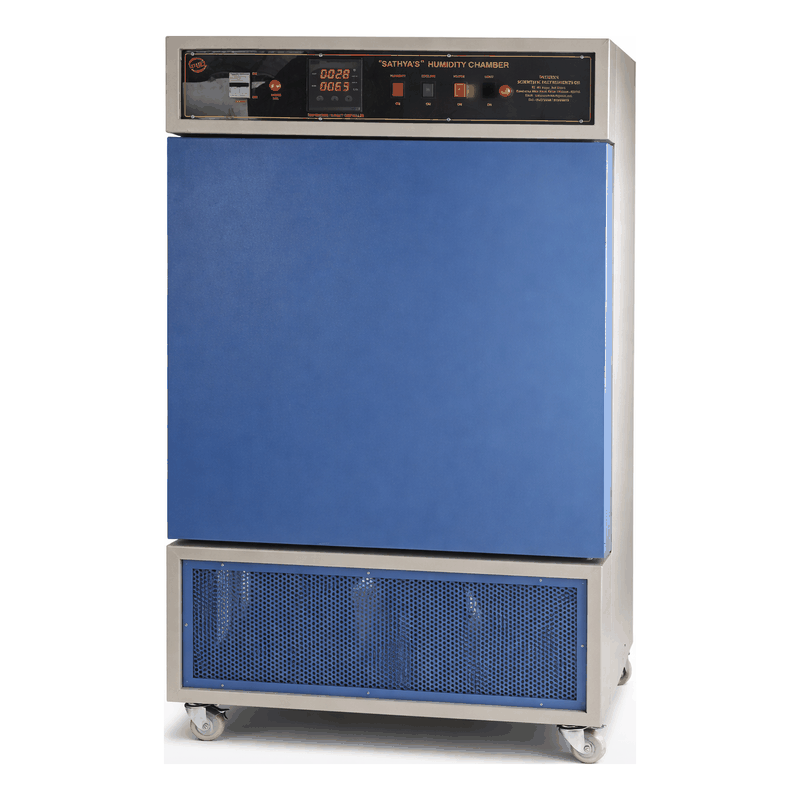
A humidity chamber primarily controls relative humidity (typically 30 %–95 % RH) while maintaining a stable temperature. An incubator focuses on temperature control (often 30 °C–45 °C) with optional CO₂ regulation for cell culture. Both can be custom‑built, but the internal layout differs: humidity chambers need sealed gaskets and condensate traps, whereas incubators require gas ports.
How do I calculate the power rating for a custom chamber?
Power (kW) ≈ (Volume × ΔT × U‑value) / (Efficiency × 3600). Here, ΔT is the temperature rise needed, U‑value is the overall heat transfer coefficient (≈ 0.5 W/m²·K for insulated steel), and efficiency accounts for heater performance (≈ 0.9). A qualified manufacturer will perform this calculation and suggest an appropriate power supply.
Can I integrate a data‑logging system with a custom chamber?
Yes. Modern controllers support RS‑485, Modbus, or Ethernet connectivity. When specifying size, also request I/O ports for external data loggers or Laboratory Information Management Systems (LIMS).
Is it necessary to have a warranty on custom chambers?
Warranty terms vary, but a minimum of one‑year comprehensive coverage on the control system and two‑year coverage on mechanical components is standard practice in India. Verify that spare parts and service contracts are available locally, especially for installations in Chennai or other tier‑2 cities.
Final Verdict and Recommendations
Getting the right chamber size is a blend of accurate volume calculation, material selection, and compliance with regulatory standards. By following the step‑by‑step sizing guide, consulting the relevant ISO standards, and partnering with a manufacturer that can provide CAD review and after‑sales support, you minimise risk and optimise operational efficiency.
Ready to discuss a chamber that fits your exact workflow? Explore our custom humidity chambers and contact the engineering team for a free design consultation.