
When you are setting up a new laboratory or upgrading an existing workflow, the question Hot Plate vs Heating Mantle: Which One Should You Buy? quickly rises to the top of the decision‑making list. Both devices deliver heat, but they do so in fundamentally different ways, and the right choice depends on the nature of your samples, the required temperature control, safety considerations, and budget constraints. In this guide we break down the working principles, key specifications, and practical selection criteria so that laboratory managers, research scientists, and procurement teams in Chennai, Tamil Nadu, and across India can make an informed purchase.
Table of Contents
- Understanding the Working Principle
- Key Components and Their Functions
- Typical Applications in Indian Laboratories
- Important Specifications to Compare
- How to Choose the Right Device for Your Needs
- Comparison with Alternative Heating Technologies
- Installation, Calibration, and Maintenance
- Safety Precautions and Common Operational Mistakes
- Questions to Ask Suppliers Before Purchasing
- Frequently Asked Questions
- Final Verdict: Which One Should You Buy?
Understanding the Working Principle
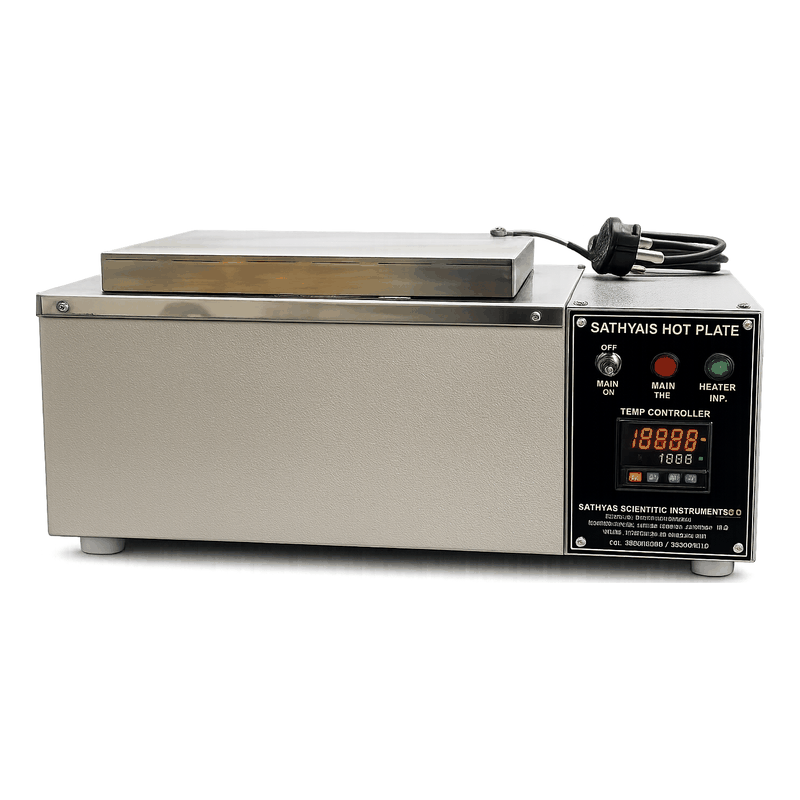
A hot plate consists of a flat, electrically heated surface, often coated with a chemically resistant material such as ceramic or PTFE. Heat is generated by a resistive element beneath the surface and transferred directly to the bottom of the vessel. Temperature is usually regulated by a simple dial, digital display, or a PID controller for tighter control.
A heating mantle is a flexible, insulated shell that wraps around the outside of a flask or reactor. Inside the mantle, an electrically heated coil or silicone‑rubber heating element distributes heat evenly around the vessel’s circumference. The mantle’s design minimizes hotspots and provides uniform heating, which is critical for reactions that require precise temperature gradients.
Key Components and Their Functions
- Heating element: Nichrome coil in hot plates; silicone‑rubber or metal‑wire coil in mantles.
- Temperature controller: Mechanical knob, digital read‑out, or PID module.
- Insulation: Ceramic or metal base for hot plates; fiberglass or silicone insulation for mantles.
- Safety features: Over‑temperature cut‑off, automatic shut‑off, and insulated handles.
Typical Applications in Indian Laboratories
Both devices are staples in quality‑control labs, pharmaceutical formulation units, academic research facilities, and industrial pilot plants. Here are common use‑cases:
- Hot plates: Sample drying, gentle reflux, magnetic stirring of low‑viscosity liquids, pre‑heating reagents, and educational demonstrations.
- Heating mantles: Precise reflux of organic syntheses, scale‑up reactions in round‑bottom flasks, distillations, and any process where uniform heat distribution is vital.
Important Specifications to Compare
| Parameter | Hot Plate | Heating Mantle |
|---|---|---|
| Temperature range | Ambient to 350 °C (typical) | Ambient to 300 °C (most models) |
| Power rating | 200 W – 1500 W | 200 W – 1200 W |
| Temperature accuracy | ±2 °C (digital) / ±5 °C (dial) | ±1 °C (PID‑controlled) |
| Capacity | Flat surface up to 30 cm diameter | Fits 250 ml – 5 L round‑bottom flasks |
| Safety | Thermal cut‑off, insulated base | Over‑heat sensor, insulated shell |
How to Choose the Right Device for Your Needs
1. Nature of the Sample
If you work primarily with aqueous solutions, low‑viscosity solvents, or need a flat surface for magnetic stirring, a hot plate is usually sufficient. For viscous, high‑boiling organic mixtures that require reflux, a heating mantle provides the uniform heat distribution that prevents localized overheating.
2. Temperature Precision
Research that demands tight temperature control—such as kinetic studies, enzyme assays, or pharmaceutical batch validation—benefits from a mantle equipped with a PID controller. Hot plates with digital displays can also meet precision needs, but they may exhibit edge‑effect temperature gradients.
3. Vessel Compatibility
Round‑bottom flasks, Schlenk tubes, and large reactors fit naturally onto mantles. Flat‑bottom beakers, petri dishes, and test tubes are better suited to hot plates. Consider the maximum flask size you will use; a 5 L mantle can handle most pilot‑scale syntheses.
4. Laboratory Space and Ergonomics
Hot plates have a small footprint and can be stacked on bench tops. Mantles require a dedicated space for the flexible shell and often need a magnetic stirrer underneath. In crowded Chennai labs where bench space is premium, a compact hot plate may be the pragmatic choice.
5. Budget and Total Cost of Ownership
Entry‑level hot plates are generally less expensive (₹8,000‑₹20,000) than mantles (₹15,000‑₹45,000). However, factor in long‑term costs: mantles often have longer service lives, lower energy consumption due to efficient heat transfer, and reduced risk of sample loss from uneven heating.
Comparison with Alternative Heating Technologies
Beyond hot plates and mantles, laboratories may consider oil baths, sand baths, or microwave reactors. Oil baths provide excellent temperature uniformity but involve hazardous oil handling and disposal. Sand baths are inexpensive but slower to respond. Microwave reactors offer rapid heating for polar solvents but are limited by vessel compatibility. For most routine organic syntheses and quality‑control heating, the hot plate‑mantle duo remains the most versatile and cost‑effective solution.
Installation, Calibration, and Maintenance
Both devices are plug‑and‑play, but proper setup ensures longevity and safety:
- Installation: Place the unit on a stable, heat‑resistant bench. Ensure adequate ventilation; mantles can generate significant heat on surrounding surfaces.
- Calibration: Verify temperature accuracy using a calibrated thermocouple or a reference thermometer. Re‑calibrate annually or after any major repair.
- Cleaning: Wipe hot plate surfaces with a soft, damp cloth; avoid abrasive cleaners that damage the coating. For mantles, remove the silicone shell, clean the exterior with mild detergent, and inspect the heating element for cracks.
- Troubleshooting: If the temperature reading drifts, check the sensor connection, clean any residue from the heating element, and confirm the power supply voltage matches the specification.
Safety Precautions and Common Operational Mistakes
- Never leave a hot plate or mantle unattended while operating at high temperature.
- Use heat‑resistant gloves and eye protection when handling hot vessels.
- Do not place flammable solvents directly on a hot plate without a magnetic stir bar; the surface can become a fire hazard.
- Avoid over‑filling flasks on mantles; expansion of vapors can cause pressure buildup.
- Never use a damaged silicone mantle—cracks can expose the heating coil and create electrical hazards.
Questions to Ask Suppliers Before Purchasing
- What is the temperature stability specification (± °C) and does it include a PID controller?
- Are spare heating elements and temperature sensors readily available in India?
- What warranty period and on‑site service options are offered?
- Is the unit compliant with IS / IEC safety standards for laboratory equipment?
- Can the manufacturer provide calibration certificates and user manuals in English and Tamil?
Frequently Asked Questions
Can a hot plate replace a heating mantle for reflux?
In most cases, no. A hot plate can initiate reflux, but the lack of uniform circumferential heating often leads to uneven boiling and “bumping.” A mantle provides consistent heat around the flask, reducing the risk of sudden eruptions.
Do heating mantles work with magnetic stirrers?
Yes. Most mantles are designed to sit over a magnetic stir bar placed inside the flask. The mantle’s flexible shell allows the magnetic field to pass through, enabling efficient stirring.
What power supply is required for a 1 kW heating mantle?
A standard 230 V, 50 Hz Indian mains supply is sufficient. Ensure the circuit can handle the current draw (approximately 4.5 A) without tripping the breaker.
Are there any certifications I should look for?
Look for compliance with ISO 9001 for quality management and IEC 61010‑1 for safety of laboratory equipment. The CDC’s chemical safety guidelines also provide best‑practice recommendations for using heated equipment.
How does ambient temperature affect performance?
Both devices compensate for room temperature via their controllers, but extreme ambient conditions (above 35 °C or below 10 °C) can affect temperature accuracy. In hot and humid Chennai labs, consider a unit with built‑in ambient compensation.
Final Verdict: Which One Should You Buy?
If your laboratory primarily conducts aqueous work, routine sample drying, or low‑temperature stirring, a reliable digital hot plate offers simplicity, low cost, and compact size. For organic synthesis, scale‑up reactions, or any application where temperature uniformity and precise control are non‑negotiable, a PID‑controlled heating mantle is the smarter investment.
Evaluate your workflow, bench space, and budget, then match the specifications to the criteria outlined above. When you are ready to purchase, explore the range of electric heating mantles from Sathya Scientific for models that meet Indian safety standards and come with local after‑sales support.

